The Boy of the White House, in the Words of Those Who Knew Him
Abraham and Tad Lincoln, 1864 (Anthony Berger, Brady studio). Lincoln later told Noah Brooks he worried this picture was "a species of false pretense": the big book was not a Bible but "a big photograph album."3
About this page (revised 2026). An earlier version of this page included quotations that could not be traced to any historical source, and some that could not be genuine: a "letter to Mercy Warren," who died in 1814; a "1909 memoir" by Robert Lincoln, who never wrote one; and a goat cart in the "Rose Garden," which was not planted until 1913. Those have been removed. Every quotation below comes from a published eyewitness or primary source, cited in the notes with author, title, year and page.
Introduction: "The Tricksy Sprite of the White House"
Thomas Lincoln was born in Springfield on April 4, 1853, the fourth and youngest son of Abraham and Mary Lincoln.4 He was named for his grandfather. His father nicknamed him "Tadpole," which shrank to "Taddie" and then "Tad."1 He had a speech impediment. Julia Taft, who saw him almost daily in 1861, wrote that it "made it difficult for strangers to understand him."2 John Hay, the President's secretary, remembered him this way:
"'Tad' was a merry, warm-blooded, kindly little boy, perfectly lawless, and full of odd fancies and inventions, the 'chartered libertine' of the Executive Mansion."
John Hay, "Life in the White House in the Time of Lincoln," Century Magazine, Nov. 1890, p.355
1861: Willie, Tad and the Taft Boys
For the first year the White House had two Lincoln boys. Willie was ten and Tad was eight. Their constant playmates were Bud and Holly Taft. The Tafts' older sister Julia wrote down what she remembered seventy years later, in Tad Lincoln's Father (1931). Because she wrote so long afterward, her dialogue is best read as memory, not transcript.
The fort on the roof. When Washington was cut off in April 1861, Tad told the Tafts: "You ought to see the fort we've got on the roof of our house. … Let 'em come. Willie and I are ready for 'em." Julia found "a small log to represent a cannon and a few old condemned rifles."6
The knife in church. The only documented knife mishap. During a church service, "a young officer … gave him his knife, thinking Tad could not open it. But he did and cut his finger and I had to bind it up with my best embroidered handkerchief."7
Pocket-knives and the green table-cover. Secretary William O. Stoddard found the office table ruined one morning. "Tad and Willie Lincoln have been here, and they are the happy owners of brand-new pocket-knives. They are sharp knives, too, that will cut outline maps of the seat of war, or of anything else, upon green cloth table-covers."8
The bells. That same morning every bell in the house started ringing and the staff rushed to the President's office. The culprit was Tad, "sitting by a central pinion or 'yoke' of the White House bell system, away up in the garret, tugging hard." Stoddard adds that the boys "have lost the entree of the garret."8
The attic circus. "Come quick, Julie. We're having a circus. I've got to be blacked up and Willie can't get his dress on and Bud's bonnet won't fit." Admission was five cents. Asked whether the President knew, Tad said: "Pa knows and he don't care, neither."9
The goats, Nanko and Nanny. Word once came from the stables "that Nanko had escaped. Nanko was a goat that had been given the boys a few days before, and they were training him to draw a small wagon." Tad "had another goat named Nannie, who was greatly attached to him."10
The court-martial and pardon of Jack the doll. Tad had a Zouave doll named Jack. The boys kept convicting him "of sleeping on post or desertion," shooting him, and burying him in the gardener's roses. The gardener suggested a pardon. Tad took the case to his father, who answered, "It's a good law that no man shall twice be put in jeopardy of his life for the same offence and you've already shot and buried Jack a dozen times." Lincoln then wrote: "The Doll Jack is pardoned by order of the President. A. Lincoln."11
February 1862: Willie's Death
Willie fell ill in early 1862 and died in February. Stoddard says both boys had the fever and that Tad was left weakened by it.13 Elizabeth Keckley, Mary Lincoln's dressmaker, helped wash and dress Willie's body. She then watched the President come in:
"My poor boy, he was too good for this earth. God has called him home. I know that he is much better off in heaven, but then we loved him so. It is hard, hard to have him die!"
Elizabeth Keckley, Behind the Scenes, 1868, p.10312
Noah Brooks, a journalist and close friend of the President, believed the loss changed how the Lincolns raised their youngest: "It was this bereavement, I think, that made Mr. Lincoln and his wife very tender and indulgent toward their youngest boy."14
1863: A Boy Among Soldiers, Goats and a Turkey
Visiting the army (April 1863). Tad went with his parents to review the Army of the Potomac. Brooks watched his "little gray riding-cloak" flying beside the reviewing party. When Tad was told to take off his cap to saluting soldiers, he said: "Why, that's the way General Hooker and Father do; but I'm only a boy."15
The pistol and the "ugly dream" (June 9, 1863). Lincoln telegraphed his wife in Philadelphia: "Think you better put 'Tad's' pistol away. I had an ugly dream about him."16
Nanny on Tad's bed (August 8, 1863). Lincoln wrote to Mary: "Tell dear Tad, poor 'Nanny Goat,' is lost; and Mrs. Cuthbert & I are in distress about it. The day you left Nanny was found resting herself, and chewing her little cud, on the middle of Tad's bed. But now she's gone!"17
The box of tools. A friend gave Tad a box of tools. Brooks wrote: "There was nothing within his reach that was not sawed, bored, chiseled, or hacked with some one of the tools of that collection. At first, he proposed setting up a cabinet-shop for the manufacture of furniture for the hospitals. … but when he began to try experiments with the old-fashioned mahogany chairs in the East Room, the box of tools mysteriously disappeared."18 This is the only documented account of Tad working on furniture. The furniture was White House chairs, the damage was not described, and the tools were soon taken away.
Jack the turkey is reprieved (December 1863). A turkey had been sent for the Christmas table, and Tad made friends with it. When it was about to be killed, Tad "burst into the room like a bomb-shell, sobbing and crying." "He's a good turkey, and I don't want him killed." The President "took a card and wrote on it an order of reprieve."19
1864: The Lieutenant, the Theater and the Food Stand
The stable fire (February 10, 1864). The White House stables burned, and Willie's pony and Tad's pony died in the fire. "Upon 'Tad's' learning of the loss, he threw himself at full length upon the floor, and could not be comforted."20
Tad's theater and the locked door. Tad had fitted up a spare room "as a miniature theatre, with stage, curtains, orchestra, stalls, parquette, and all." When the painter F. B. Carpenter's photographers used the room without asking, Tad locked them out and kept the key. Lincoln fetched the key himself and explained afterward: "Tad is a peculiar child. He was violently excited when I went to him. I said, 'Tad, do you know you are making your father a great deal of trouble?' He burst into tears, instantly giving me up the key."21
"A board and some plank" (May 1864). Notes acquired in 2025 by the Lincoln Memorial Shrine in Redlands, California, show the family arranging work on Tad's room. The Commissioner of Public Buildings noted, "Wrote Mr. Haliday to do the work Tad wanted." A separate note from Mary asks for "a board and some plank" for Tad. What the lumber was for is not recorded.22
"Especially the goats" (April 28, 1864). Mary telegraphed from New York that Tad wanted to know if the goats were well. Lincoln answered: "Tell Tad the goats and father are very well — especially the goats."23
Lieutenant Tad. Secretary of War Stanton, "for the fun of the thing, commissioned him a lieutenant." Tad ordered muskets delivered to the house, drilled the servants and gardeners, and relieved the regular sentries. Robert Lincoln complained, and his father "only laughed at the matter as a good joke." Tad got a uniform and was photographed in it.24
"He isn't of age yet." In 1864 the turkey Jack was walking among the Pennsylvania "Bucktail" soldiers as they voted. Lincoln asked Tad, "Does Jack vote?" Tad answered: "Why, no, of course not. He isn't of age yet."25
The toll gate and the food stand. Tad charged visitors on the staircase five cents "for the benefit of the Sanitary Fund." Later he bought out an apple-and-gingerbread seller's stock and "set up his shop in the grand, historic portico of the White House." By nightfall he had spent all his profits.26
The Fast Day picnic. Tad was alarmed by a proclaimed day of fasting and hid food under the carriage seat. When the coachman found it, Tad cried: "Oh! oh! give that up, I say! That's my Fast Day picnic!" His father said: "If he grows to be a man, Tad will be what the women all dote on — a good provider."27
"Let him run." Tutors "came and went, like changes of the moon." The President's view, as Brooks recorded it: "Let him run; there's time enough yet for him to learn his letters and get poky. Bob was just such a little rascal, and now he is a very decent boy."28
A dollar, and flowers. On a boat to Fortress Monroe, Lincoln promised Tad a dollar to keep quiet, and Tad didn't. Lincoln paid anyway: "Well, my son, at any rate, I will keep my part of the bargain." Another time he asked Commodore Porter to send men ashore with Tad to pick flowers.29
Getting a doorkeeper his job (December 31, 1864). Doorkeeper Thomas Pendel remembered Tad bringing in his appointment papers: "Papa, dear, do me a favor? … Sign this for Tom Pendel." The President signed it.30
April 1865: Flags, a Speech and a Terrible Night
April 10. Two cards in Lincoln's hand survive: "Tad wants some flags. Can he be accommodated," addressed to Stanton, and "Let Master Tad have a Navy sword," addressed to Secretary Welles.31
April 11: the last speech. The White House was lit up and a crowd filled the grounds. Tad waved a captured Confederate flag out of a front window until old Edward, the butler, pulled him back: "The likes of it, Mister Tad … the likes of a rebel flag out of the windows of the White House!" As the President read his speech and let each finished page fall, Tad crawled behind him collecting them and whispered, "Come, give me another!"32
April 14. While his parents were at Ford's Theatre, Tad was at another theater. Pendel calls it the National Theatre; it is usually identified as Grover's. Word of the shooting reached him there, and he ran back to the White House. Pendel wrote:
"O Tom Pen! Tom Pen! they have killed papa dead. They've killed papa dead!"
Thomas F. Pendel, Thirty-Six Years in the White House, 1902, p.4433
Pendel put Tad to bed near midnight and lay beside him until he fell asleep. Carpenter heard that on the Sunday after the assassination Tad asked a visitor whether his father had gone to heaven, then said: "I am glad he has gone there, for he never was happy after he came here. This was not a good place for him!"34 Keckley heard Tad comfort his mother at night: "Don't cry, Mamma; I cannot sleep if you cry! Papa was good, and he has gone to heaven." She also recorded him saying: "I am only Tad Lincoln now, little Tad, like other little boys. I am not a President's son now."35
The funerals. At the East Room service on April 19, Mary Lincoln was "unable to leave her room, where she remained with Tad."36 Neither of them rode the funeral train west. Keckley's account keeps Mrs. Lincoln and Tad at the White House through the weeks after the assassination, while the train carried the President's body west: "For five weeks Mrs. Lincoln was confined to her room."36
1865–1871: Chicago, Europe and Home Again
Chicago hotels (May 1865 to 1866). Mary, Robert and Tad spent one week at the Tremont House and then took rooms at the Hyde Park hotel. There, Keckley says, "Tad roomed with Robert."37 A reading lesson there did not go well. Shown a picture of an ape, Tad insisted "A-p-e" spelled "Monkey": "Don't I know a monkey when I see it?"38
His father's washstand. Keckley says the only furniture Mary took from the White House was "a little dressing-stand used by the President." She took it to Chicago "for the benefit of little Tad," after putting a better one in its place. What happened to it afterward is unknown.39
375 West Washington Street (1866 to May 1867). Mary bought a house and furnished it new. In June 1867 the furniture was auctioned. A Chicago report reprinted in the Washington National Republican lists "Tad's chamber set for $150."40
Boarding with the Coles (October 1867 to January 1868). Mary and Tad took furnished rooms in the house of David Cole, a builder, at 460 West Washington Street. Mary wrote: "My parlor and bedroom are very sweetly furnished."41
The Clifton House (January 1868 on). "I have moved my quarters to this house." A few days later Mary wrote of going out "with Tad … in a street car."42
Frankfurt: Dr. Hohagen's school (late 1868 to 1870). By February 1869 Tad was boarding at a school in Frankfurt am Main. Mary sent Robert "Dr. Hohagen's bills" and reported: "Taddie, writes me, he has outgrown all his clothes."43 In March she found "my dear boy, much grown."44 In October he was away on "an alternate walking & riding voyage — with his Professor & the pupils in the school."45
England: a tutor at Leamington (autumn 1870). Mary wrote from Leamington: "From 8 until 1 o'clock each day Tad is seated at his table — with his tutor studying & from 5 to 7 — each evening … Tad — now realises the great necessity of an education, & I am sure will do well."46 Brooks says that in Europe Tad "quite overcame the difficulty in his speech," though he was left with "a slight German accent."47
Home, and death (May to July 1871). Tad and his mother returned in May 1871. He fell ill soon after, and died at the Clifton House on Wabash Avenue on the morning of July 15, 1871, aged eighteen. The Chicago Tribune reported that he "bore his illness with great patience and resignation."48 His funeral was held at the First Presbyterian Church in Springfield on July 17. He was buried in the Lincoln tomb at Oak Ridge Cemetery.49 Brooks wrote that "he gave to the sad and solemn White House the only comic relief it knew."47
Knives, Tools and Carving: What the Record Actually Says
Knives, tools and carving come up often on this site, so here is the complete list of documented episodes found so far:
1861: cut his finger opening an officer's knife in church (Taft Bayne).7
1861: with Willie, used new pocket-knives to cut "outline maps of the seat of war" into a green cloth table-cover (Stoddard).8
c. 1863–64: a gift box of tools; "sawed, bored, chiseled, or hacked"; plans for a "cabinet-shop"; "experiments with the old-fashioned mahogany chairs in the East Room" (Brooks).18
1864: work on his room by the White House carpenter, and "a board and some plank" (Lincoln Memorial Shrine notes).22
No documented anecdote has been found of Tad carving letters, dates or pictures into furniture, or of him whittling, at any time from 1861 to 1871. That includes Keckley, Carpenter, Stoddard, Brooks, Pendel, Hay, Julia Taft Bayne, Mary Lincoln's letters of 1867–1871, and the Chicago newspapers checked. The sources do show a boy who liked tools and was allowed to use them, which is as far as the record goes.
Sidebar: Big Brother Robert Is Fined Two Dollars (1860)
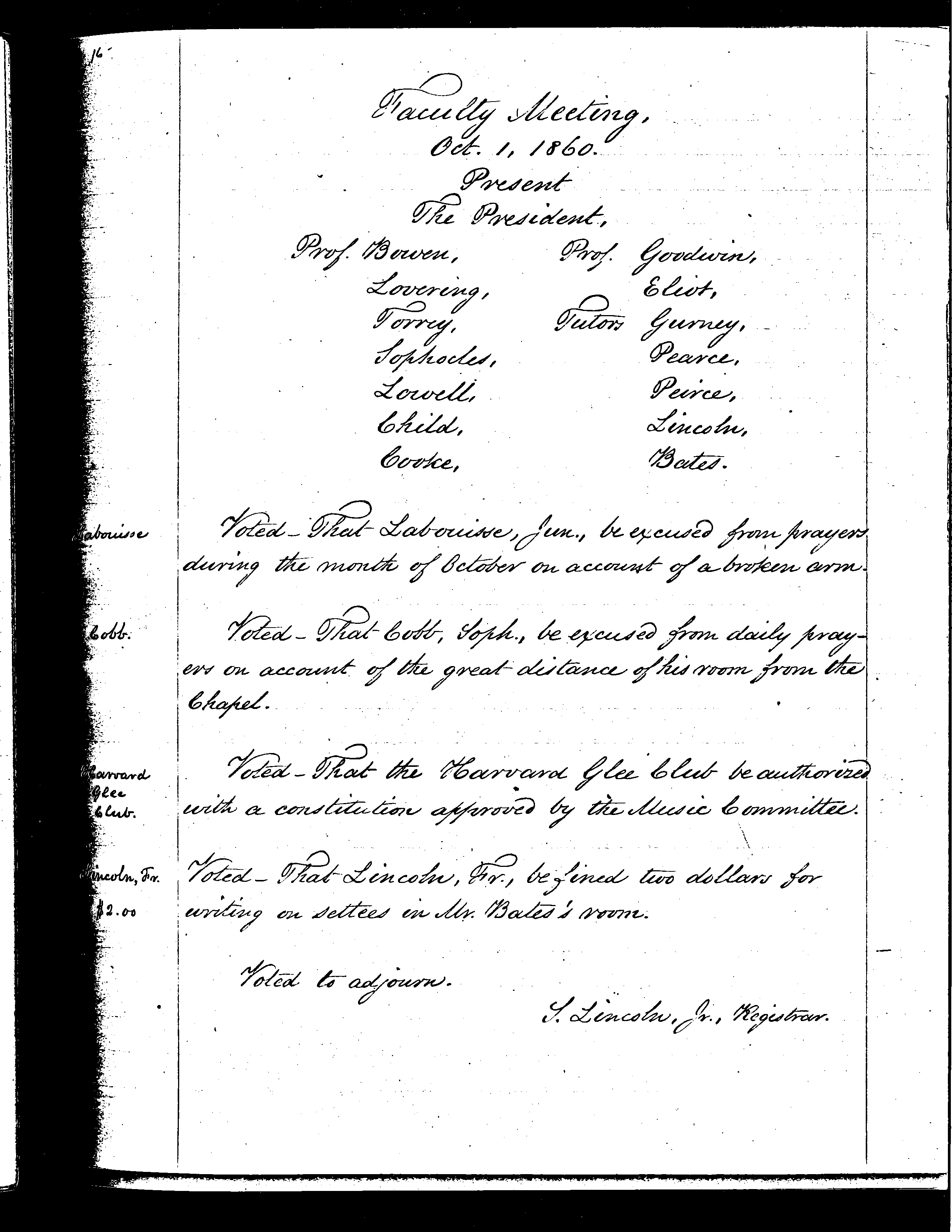
Before Tad ever reached the White House, his brother Robert had his own run-in with furniture. The minutes of the Harvard College Faculty meeting of October 1, 1860 record:
"Voted — That Lincoln, Fr., be fined two dollars for writing on settee[s] in Mr. Bates's room."
Harvard College, Faculty meeting minutes, Oct. 1, 1860, p.16. Margin: "Lincoln, Fr. $2.00."50
"Fr." means freshman. Robert entered Harvard in 1860 with the Class of 1864. The official list of that class, including every member who left without graduating, has only one Lincoln: Robert Todd Lincoln.51 The registrar who signed the minutes, "S. Lincoln, Jr." (Solomon Lincoln Jr.), and the "Tutor Lincoln" in the attendance list were faculty, not students, and no relation. "Mr. Bates" is presumably the Tutor Bates also listed as present.
This is family color. It tells us something about Robert at seventeen, and nothing about Tad.
Tad after 1865 and the Reedy Chest
The chest that started this project is an Empire-style flame-mahogany chest of drawers of about the 1840s–50s. It has three small top drawers (the center one tiny and keyed), one deep drawer and three long drawers, with barley-twist columns and a rope-twist apron. "TAD" is carved on the top. The rear panel shows "TAD," the words "DIED ON," a backwards "1865," and a mourning scene. I bought it in Clendenin, West Virginia, in November 2012 for $300.
Please read this as a hypothesis. I believe Tad Lincoln may have carved this chest. No document yet links this chest, or any chest like it, to Tad or the Lincoln family, and none of the sources above describes Tad carving furniture. What follows is the documented timeline of where Tad lived after April 1865, which is when and where such carving would have had to happen if it happened at all.
Mary Lincoln's house, 375 West Washington St., Chicago
Family's, furnished in 1866. Auctioned June 1867, including "Tad's chamber set," $150. No record found gives its buyer or its wood. The auction advertisement mentions black walnut chamber sets and says the furniture was "made to order," but it does not describe Tad's set in particular.40
The honest assessment is this. The Chicago years, 1865–1868, are the only period in which Tad could have cut an inscription like "DIED ON … 1865", and in those years he mostly lived with other people's furniture. His own documented bedroom set ("Tad's chamber set") was sold to an unknown buyer in June 1867, and no record found so far gives its wood, style, or pieces. Whether a c.1840s mahogany Empire chest could have been part of it is an open question. The chest could also fit a hotel or boarding-house room, but no record places one there. The carving would therefore need independent evidence: provenance before 2012, a forensic study of the tool marks and the age of the carving, or a document that names the piece.
Research in progress. Requests have gone to archives and libraries for (1) a Chicago newspaper report of the June 1867 auction that might name who bought "Tad's chamber set," (2) Cook County probate records that might list household furniture, and (3) expert examination of the carving. Results will be posted here, including any that count against the hypothesis.
Notes and Sources
Page numbers are those of the printed editions. Most sources are free on the Internet Archive (archive.org). Quotations follow the originals, with obvious scanning errors corrected.
F. B. Carpenter, Six Months at the White House with Abraham Lincoln (New York: Hurd & Houghton, 1866), p.44. [archive.org: sixmonthsatwhite00carp]
Julia Taft Bayne, Tad Lincoln's Father (Boston: Little, Brown, 1931), p.7. [archive.org: tadlincolnsfathe00bayn]
Noah Brooks, Washington in Lincoln's Time (New York: Century, 1895), pp.284–285; see also Carpenter (1866), p.93. [archive.org: washlincolnstime00broorich]
Noah Brooks, "A Boy in the White House," St. Nicholas 10, no.1 (Nov. 1882), p.57 (birth date). [archive.org: sim_saint-nicholas-a-magazine-for-boys-and-girls_1882-11_10_1]
John Hay, "Life in the White House in the Time of Lincoln," Century Illustrated Monthly Magazine 41, no.1 (Nov. 1890), p.35.
Bayne (1931), p.68.
Bayne (1931), p.31.
William O. Stoddard, Inside the White House in War Times (New York: Charles L. Webster, 1890), pp.50–51. [archive.org: insidewhitehouse00stod]
Bayne (1931), pp.102–103.
Bayne (1931), p.113.
Bayne (1931), pp.131–137 (the note itself p.137). The note is also printed in Roy P. Basler, ed., The Collected Works of Abraham Lincoln (1953), vol. 8, p.425, taken from Bayne.
Elizabeth Keckley, Behind the Scenes; or, Thirty Years a Slave and Four Years in the White House (New York: G. W. Carleton, 1868), pp.100–105 (quotation p.103). [archive.org: behindscenes00keck]
Stoddard (1890), p.218.
Brooks, "A Boy in the White House" (1882), p.58.
Brooks (1882), pp.62–63; Brooks, Washington in Lincoln's Time (1895), pp.45–54.
Lincoln to Mary Lincoln, telegram, June 9, 1863, Collected Works, vol. 6, p.256 (as cited by the Abraham Lincoln Presidential Library and others). Bayne (1931), p.131 quotes it in slightly different words.
Lincoln to Mary Lincoln, Aug. 8, 1863, Collected Works, vol. 6, pp.371–372 (text as reproduced by Mr. Lincoln's White House, Lehrman Institute).
Brooks (1882), pp.58–59.
Brooks (1882), p.59.
Carpenter (1866), pp.44–45.
Carpenter (1866), pp.91–92; retold in Brooks (1882), p.59.
Lincoln Memorial Shrine (A. K. Smiley Public Library, Redlands, Calif.), "Lincoln the Family Man," on notes of May 1864 by Abraham and Mary Lincoln, J. P. Usher and B. B. French, acquired 2025 (lincolnshrine.org).
Lincoln to Mary Lincoln, telegram, April 28, 1864, Collected Works, vol. 7, p.320 (with Mary's telegram quoted in the note). [archive.org: collectedworksof015583mbp]
Auction advertisement, Wm. A. Butters & Co., Chicago Tribune, June 6, 1867, p.4; sale report, "Sale of Mrs. Lincoln's Furniture," National Republican (Washington), June 12, 1867, p.3, reprinted from a Chicago paper (Library of Congress, Chronicling America). Summer 1867 at a Racine hotel: National Republican, Aug. 16, 1867, p.1.
Mary Lincoln to Elizabeth Keckley, Chicago, Oct. 13 [1867], in Keckley (1868), appendix, pp.336–337 (with the direction "care of D. Cole," 460 West Washington St.); Edwards' Annual Directory … of Chicago (1867): "Cole David, builder, 460 W. Washington."
Mary Lincoln to Keckley, Clifton House, Jan. 12 [1868] and Jan. 15 [1868], in Keckley (1868), pp.362, 366.
Mary Lincoln to Mary Harlan Lincoln, Nice, Feb. 22, 1869. Lincoln Financial Foundation Collection, Allen County Public Library (ACPL), Insanity File Collection; ACPL CONTENTdm item 6659.
Mary Lincoln to Mary Harlan Lincoln, Frankfurt, March 22, 1869, ACPL item 6670.
Mary Lincoln to Mary Harlan Lincoln, Frankfurt, Oct. 16, 1869, ACPL item 6701.
Mary Lincoln to Mary Harlan Lincoln, Leamington, Sept. 16, 1870, ACPL item 6759.
Brooks (1882), p.65; Brooks (1895), p.279. Brooks dates the departure for Europe to 1869, but Mary Lincoln's letters show Tad in school in Frankfurt by February 1869.
"Death of Thomas Lincoln, Youngest Son of the Late President," Chicago Tribune, July 16, 1871, p.3 (Library of Congress, Chronicling America; wording checked against a poor scan).
Chicago Tribune, July 17, 1871, p.1 (Springfield dispatch) and July 18, 1871, p.1 (report of the July 17 funeral and burial at Oak Ridge).
Harvard University Archives, Faculty of Arts and Sciences, minutes of the College Faculty ("Records of the College Faculty"), meeting of Oct. 1, 1860, p.16. The Harvard Library's guide to the Tolman index gives the call number for the faculty minutes, 1725–1867, as UAIII 5.5; the volume number for 1860 is not confirmed here. Transcribed from a photograph of the original; the word "settees" may be singular.
Harvard College, Class of 1864, Secretary's Report, No. VII, 1864–1904 (Boston, 1904), pp.13–15 ("Members of the Class": graduates and non-graduates). [archive.org: harvardcollegec05goog]